ABOUT THE SHOW
A dime can be in your pocket today and in California tomorrow. Who can
image where else it has been?
ARTIST STATEMENTS
Susan Berstler
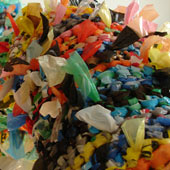
This sculpture is made up of hundreds of thousands of strips of plastic
bags, each one generated by a purchase. Although I would guess that the
vast majority were part of credit card transactions rather than payments
in cash, this piece stands as a monument to the convoluted (yet widely
promoted) concept that shopping is patriotic! Personal debt, national
debt, and the forgotten notion of a savings account are the inspiration
behind this work.
Teresa Dovidio
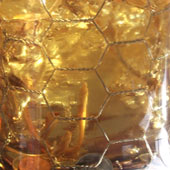
I have always been facinated with elements of luck. The break of a
wishbone or a flip of a coin are just two of the many ways one can make a
choice when faced with indecision. In this piece I wanted to restrict the
options of change. Wishbones trying to rise from a pile of coins waiting
to be tossed, within a fence of chicken wire encased in resin. Change
resistant. I produced this piece while taking a class to reinvigorate my
feelings concerning artmaking. In the end I did indeed change my whys,
whats and hows about art in my life.
Todd Fairchild
Penny Ladder is a nostalgic tribute to the penny.
Imagine facing the reality that it costs more to produce you than you are
worth; knowing that you are filled with sub-standard materials, where
your predecessors were made of pure and glorious copper; or knowing that,
long long ago, nurturing adults taught their children 'a penny saved is a
penny earned' and 'save your pennies for a rainy day', whereas now,
children have their sights set on $400 phones and million-dollar
salaries.
As an adult who is seriously challenged in money management, I have
meditated on the value of the single penny and see that it is the
fundamental element for all currency - and only through proper
respect and appreciation, can I prevent the larger coins and bills from
running amok and ruining my chances of ever having a savings account.
http://toddfairchild.com • EMAIL
Katie Hargrave
I am interested in the notions of public memorial and place making. The
production of place, I have found, depends on the private memory of
residents and the public marketing of the place's past into a digestible
narrative for the outside world. My research focuses on history as a venue
for memorial. Certain histories are privileged and marketed, while others
are inexplicably evaded. This push and pull is presented in public
institutions such as the museum and the archive and works to produce place.
For "Turn on a Dime," I look to the narrative of the American cent as
discarded yet sacred, and I look to the personage of Lincoln.
http://katiehargrave.us
Greer
Muldowney
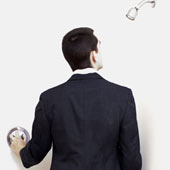
The work that I have decided to display reflects my fears about choosing a
career path, and how much money may inevitably change or conform me.
Being a young idealist, I felt the need to run with the idea that
illustrates how money may change or constrict the burgeoning spirit into a
claustrophobic, anonymous drone. In this pursuit I over dramatized the
world of Corporate America into a sterilized hell. Though there are many
grey areas between working at your local family friendly co-op to
say....big a oil conglomerate, the world I have created knows nothing of
these middle grounds. It has taken on these absolute values of black and
white, though I have left the hint of color to reflect the tiny bit of
humanity that is still in these anonymous figures. I hope the viewer can
appreciate the life being sucked out of the newly appointed corporate
underlings and their respective environment, and equally realize this is
the future (but not really).
Just a note, I work in a cube. For the record, I enjoy my job.
EMAIL
V Van Sant
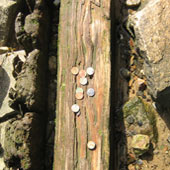
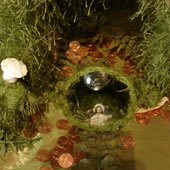
"the grass has grown over it" is an altar created in a
post apocalyptic future. In this world, coins continue to travel, but
their use has evolved as has the world. Over time these altars form as
all types of items are left by people, then taken by others. Like a giant"take a penny, leave a penny" bowl, one man's trash becomes another one's
treasure. Money has no worth because there is nothing to buy. Coins gather
because people who pass by drop them here. It might be a leftover
tradition of a "wishing well" of sorts.
The penny now costs over 3¢ to manufacture. How long will it be before it
has no value as a coin? Here, now, at this altar, some survivors exist.
Their role might be a weight for a fishing line, a tool for scraping, or
even a token of the old-fashioned notion of "good luck", but they are not
for spending. Yet they come and they go...
http://www.vvansant.artworldtapestry.com
Erika Sidor
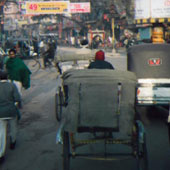
Curiosity about the world around me has taken me to
many places in the last few years. A recent trip to India awakened in
me an awareness that only a third world country can. The abject poverty
that surrounded me every day was a startling contrast to the cities here
in the USA that I have visited, and it left me shocked and confused. I
can only look back at India in awe, and wonder how it is possible that
people can survive in such adversity. Money plays such a huge role in
the quality of life for everyone in the world, and there is a striking
contrast between the images I have chosen: Las Vegas, USA (city of
money) and Varanasi, India (city of despair). The travelling I have
done will always include some element of photography, not only to help
me remember what I have seen but to share with others the way people
live in the far corners of the world.
http://www.pbase.com/erikajake • eMAIL
Martin Ulman
My experience with money all stems from my parents who's "Lived thru the
Depression" mentality greatly influenced how I was brought up. An
allowance was out of the question, so creative means were needed to have
spending money. One of the best methods was to look under the sofa pillows
after my parents friends had visited. It was like mining, you never knew
what was to be found. Another way was to always walk with your eyes down
in the event that lost coins were on the ground. I
especially was fond of the pennies that had been lying on the street and
had been run over by cars and trucks. These coins were barely recognizable
because of the damage. I sometimes wondered what the banks did with them
when they eventually found their way back to the vaults.
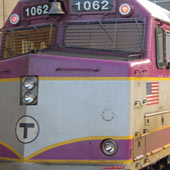
The Generation Gap, which was assembled with the remembrances of those
times, was a collaborative made video using both my family and neighbors
as actors, and the MBTA Commuter Train as the central connecting player.
It revolves around an Architect whose life is surrounded by individuals
who do not appreciate... the need or the value of the penny... both
monetarily and historically.
http://www.roslindalestudio.com
Hannah Verlin
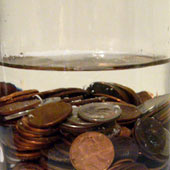
We believe that pocket-change can make changes. We throw coins into
water-wells making wishes and hoping for change. The act transforms the
value of our coins from a few cents into our priceless hopes and dreams.
'Wishing-Well' investigates wishing and want, as well as the value of
money: how money transforms from metal and paper into hopes.
Viewers are invited to select one of the wishes labled on the shelves and
drop a coin into the jar on the shelf to make that wish. Coins can be
collected from the nearby pile. The water level in the jars will rise with
the addition of coins, palpably depicting the accumulating wishes.
Randy Winchester
Despite its modest trash-picked origins, Randy Winchester's "Conveyor
Belt for Change" references a tool that helped speed the Industrial
Revolution and remains in wide spread use today. Conveyor technology is
used to transport everything from people on moving sidewalks to products
on manufacturing assembly lines. While the treadmill conveys ideas of
monotonousness sameness, the conveyor belt is also a device to
manipulate objects by moving them through space and time, thus producing
change. "Conveyor Belt for Change" asks the viewer to look within
his/her pockets and deposit coins on the moving belt. These coins may
then travel throughout the gallery to interact with other pieces.
Deposit your change to help institute change! |