David Colombo: email
Over the last few years, my work seems to be depicting collections of
things. Some of the black and white etchings are simply depicting groups
of sculptures, inanimate 3 dimensional forms on a sort of tabletop, which
can easily be changed into a landscape with more detailed plants and
animals.
In my most recent work, the collection of things happens to be birds,
taken from Audubon’s “Birds of America” series. There seems to be
something very “American” about taking groups of things from the natural
world, and needing to name, arrange and collate them.
Christopher Frost
Christopher Frost is a sculptor interested in exploring the everyday object through material and context. His belief that encountering the ordinary (be it hat, fish or building) through a new perspective can create unexpected, humorous and often poignant interpretations. He works in cast forms in bronze and concrete. He lives and works in Somerville.
Gina Kamentsky
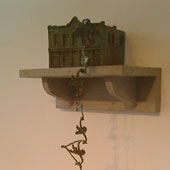
In 1981, Having earned a BS in Industrial Design and Film Animation at
Philadelphia College of Art
Gina Kamentsky began working as a designer for Fisher Price Toys in
Buffalo New York leaving in the
mid 80s to set up an independent studio inventing toys for the
commercial market. When not
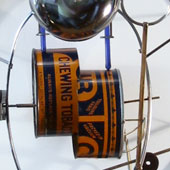
concentrating on her commercial endeavors, she began creating
mechanical contraptions and
illuminated sculptures using found metal objects.
Gina continues this exploration in form and movement producing kinetic
sculpture for the wall
involving electronic and mechanical components and is in the process of
compiling a DVD retrospective
of her personal animation work and a series of collages based on her
film work.
Jane Maxwell: email
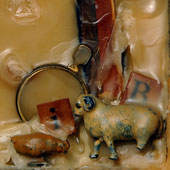
Jane Maxwell is a mixed media artist. Her work featured in the Nave Gallery show is from her Wax Assemblage series built with found objects and beeswax. For years, she has been drawn to antique flea markets and all of the small, wonderful treasures found there. She has collected vintage bingo numbers, metal doll furniture, doll clothing, printing letters, old pencil leads, wire, clock parts, game pieces and many other objects. She also enjoys the unique quality of beeswax and encaustic (a wax-based paint). It was during a 3 a.m. wake-up that it dawned on Jane to combine these two elements. What developed were assemblages featuring antique collectibles emerging from a thick encasing of wax. There is an archeological sensibility to this work, which in a way mirrors her many hours spent unearthing these antique treasures. It also alludes to the layers of human complexity that hide just below the surface waiting to be explored.
Jane's work has been featured in exhibitions throughout New England and beyond. Her work is published in several books on collage, including Collage Sourcebook (Quarry Books, 2005) and Collage for the Soul (Rockport Books, 2003). Her work will also be featured in a book entitled Potentia, due for publication by Random House in 2007.
Luis Montalvo: email
Luis Montalvo attended Fordham University where he earned his bachelors of arts degree in art history spending the junior year of studies in Paris with Columbia University. He earned his masters of architecture from Yale University in 1992. Upon receiving a Fulbright Scholarship and a Graham Foundation Grant, Luis transferred to Mexico to study interdisciplinary collaborations within the work of architect Luis Barragán.
Luis Montalvo has taught and lectured in art history as well as architectural theory and design since 1993. Luis is currently the Director of Media Arts at the Boston Architectural Center where he is responsible for curriculum development in the fields of drawing, photography, and media.
Neal Stennett: email
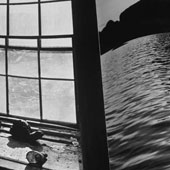
I love light. I have always loved light, the way it casts it glow on the surface of objects, human skin, reflections off the ocean and the long cast of an afternoon shadow, with all its rich detail. That is how I got started in photography, with the use of light and how I could capture it and re-create it for how I in vision it to have been. I have been shooting images for well over 20 years, growing with my creative process and vision. I have also used many other materials to create my ideas, from artist books to college of my work, to found art sculptures.
What I find exciting is how to create illusions with light and how to portray it to be real, real for the world to believe. My subject matter takes on many forms.
For a series I am working on now, I am re-creating a visual languages with the use of vintage magazine ads, shooting all of them with a large format camera of the same era, folding and bending pages and images, pushing our beliefs and ideas of our/their time. I am creating a modern day story of mixed up ideas of identity, places in our society, images you would not normally see together. To challenge our understanding of societies expectations. This body of images has an odd state about them, something isn't right.
David P. Wells: email
David Wells was born in Northern New York. He has a BA degree from State University of New York at Potsdam and an MFA in Painting from the Rhode Island School of Design. His work has been exhibited nationally and internationally. David’s paintings and drawings have been shown at Art Institute of New Hampshire, Soprafina Gallery, drawings at Bernard Toale Gallery, ‘Boston Drawing Project’, , and Fidelity Investments. In support of the artist’s work, David has taught at the Rhode Island School of Design, Marshall University, public and private schools. He has recently exhibited new paintings at the Florence Biennale 2005, Florence Italy.
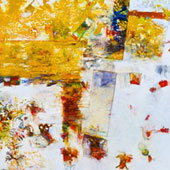
David describes his work; drawings and paintings, as energetic, spirited, linear, constructed using pictorial space. Provoking accidents he prompts constant change in his visual vocabulary. He is a true painter’s painter, admired for his sensitivity to the many textures of paint, and respected for his uncanny ability to reinvent its form. Poetic narratives are present in his imagery giving way to whimsy, light, and unresolved mystery. Gestural paint passages can be somber and dark, others joyful, with subtle transitions in contrasting ethereal spaces. Intuitive references to the literal emerge, disappear and emerge again as the work progresses.
|